

Teaching reading in English is not the same as teaching reading in Spanish. This statement may seem obvious, but it has profound implications for the classroom. Many English teachers in Spain have received training on the language, grammar, vocabulary, and oral communication, but not always on the specific processes involved when a student learns to read in English as a second language.
Spanish has a relatively stable relationship between letters and sounds. In English, on the other hand, the same letter or combination of letters can be pronounced differently depending on the word. Therefore, strategies that work for teaching reading in Spanish cannot always be directly transferred to English.
To delve deeper into this challenge, we organized the webinar How to Teach Reading in English: Practical Strategies for Pre-Primary & Primary Teachers, led by Leticia, from the Innovation and Professional Development team at Milton Education, and María Fernández Valverde, director of CEIP de Prácticas Asunción Rincón and expert in Science of Reading.
During the session we analyzed how to learn to read in a second language, what skills should be developed from pre-primary and primary school, and how to provide students with tools that allow them to approach texts with greater autonomy and confidence.
Here are the ten main lessons learned.
1. Learning to read in English doesn't work the same way as learning to read in Spanish.

The first step is to recognize that Spanish and English have very different spelling systems. Spanish is considered a relatively transparent language: the correspondence between graphemes and phonemes is generally stable. When a student learns the sound associated with a letter, they can apply it quite regularly to different words.
English is a much more opaque language. The same letter can represent different sounds, and the same sound can be spelled in several ways. This increases the processing load that students face when trying to read a new word.
Therefore, it is not enough to simply apply the same literacy strategies used in Spanish to English. Instruction must explicitly consider the phonological and orthographic particularities of each language. This comparison between the two languages was the starting point of the webinar.
What does this mean in the classroom?
The teacher must anticipate which sounds, combinations, and structures may be especially difficult for a Spanish speaker.
For example, certain English phonemes do not exist in Spanish, while certain consonant clusters appear much less frequently. This explains some common pronunciation and decoding errors.
These errors are not random. In many cases, they are the logical result of trying to apply to English the rules that the student already knows in Spanish.
2. Students do not start from scratch
A student learning to read in English as a second language is not in the same situation as an English-speaking child discovering reading for the first time. Our students already possess knowledge of language, sounds, words, and, depending on their age, of how reading and writing in Spanish work.
This prior knowledge is an advantage, but it also influences how they interpret the written English system. Therefore, when planning instruction, it’s helpful to ask:
- What reading skills have they already mastered in Spanish?
- What knowledge can they transfer to English?
- What sounds and patterns are common to both languages?
- What elements are new and require more intensive teaching?
The goal is not to teach them to read again from scratch, but to help them understand how a different written code works.
3. Comparing both languages allows you to focus your effort where it is most needed.

Not all sounds and letter-phoneme relationships require the same amount of instruction time. Some transfer relatively easily from Spanish to English. Others are partially similar. And some are completely different. This comparison allows for a much more strategic use of classroom time. Instead of dedicating the same number of sessions to all sounds, we can reinforce those that pose a real challenge for Spanish-speaking students.
It also helps us interpret certain common errors. For example, with the /s/ sound, when a student says “esnake” instead of “snake,” it doesn’t necessarily mean they didn’t hear the word correctly. They may be adding an initial vowel to adapt the pronunciation to a phonological structure that sounds more natural to them in Spanish. Analyzing these contrasts prevents us from teaching in a vacuum and allows us to make decisions based on the real needs of our students.
4. Exposing students to written words is not enough
Filling the classroom with posters, labels, and books is positive, but exposure alone doesn’t guarantee that students will learn to decode. Seeing the word “blackboard” written on a label every day doesn’t necessarily mean that a student understands how its letters and sounds relate to each other. For reading to progress, we need to teach the tools that allow us to decipher the code.
The webinar emphasizes a fundamental idea: English literacy requires explicit, direct, and structured instruction. It is not acquired solely through natural contact with written texts.
This implies:
- model how a word is segmented;
- teach the relationship between letters and sounds;
- explain frequent patterns;
- practice how sounds combine;
- review what has been learned in a systematic way;
- accompany the student until they can apply the strategy on their own.
The goal is not to memorize each word in isolation, but to develop tools that can be transferred to words they do not yet know.
5. The Science of Reading offers a clear framework for teaching reading

When we talk about teaching reading in English, it’s easy to focus solely on sounds, letters, or vocabulary. However, the Science of Reading reminds us that reading is a much more complex skill.
During the webinar, Maria presented one of the most recognized models in this field: Scarborough’s Reading Rope, a theoretical framework that explains how students become competent readers.
This model distinguishes two main components that work together:
- Language Comprehension, which includes vocabulary, language knowledge, listening comprehension, and world knowledge.
- Word Recognition, which encompasses the skills needed to recognize words automatically.
Although both are essential, the webinar focused on Word Recognition, as it is the area in which many English teachers receive the least specific training.
The goal is for word recognition to become automatic. When a student stops dedicating all their effort to deciphering how to pronounce a word, they can concentrate their cognitive resources on understanding what they are reading.
In other words, decoding is not the final goal, but the path to reading comprehension.
6. Phonological awareness begins long before reading words
One of the concepts that most surprised many attendees was that of phonological awareness. Although it is often associated with reading, this skill can actually be developed even before the introduction of written language.
Phonological awareness involves developing the ability to listen to, identify, and manipulate the sounds of language. It includes skills such as:
- to identify the initial or final sound of a word;
- recognize rhyming words;
- segment syllables;
- combine sounds to form words;
- add, delete or replace phonemes.
The most interesting aspect is that these activities can be carried out entirely orally, accompanied by games, clapping, movements, or gestures, without the need for written text. Precisely for this reason, María emphasized that they can be incorporated from early childhood education onward without interfering with the learning of literacy in Spanish.
Furthermore, it’s not necessary to search for specific materials to work on these skills. One of the most practical ideas from the webinar was to leverage the vocabulary already being used in class.
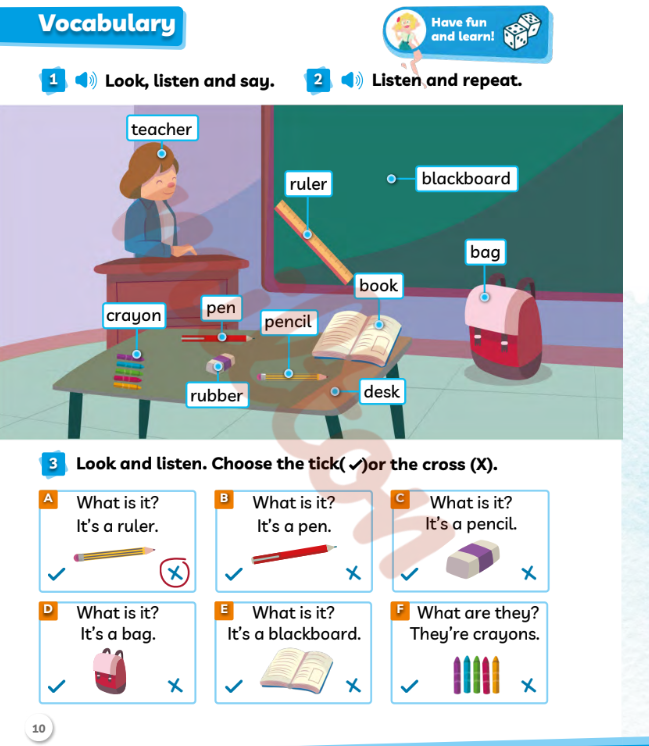
To illustrate this, María used a page from one of our primary school curriculum books, from the Time Travellers series, the method used in her school. Using words like desk, teacher, ruler, rubber, and blackboard, she showed how it’s possible to develop phonological awareness activities without preparing any additional materials.
For example, we can ask students to identify the first or last sound of a word, find other words with the same phoneme, or compare the sounds of different words. These are brief activities, easy to integrate into the daily routine, and they help build the necessary foundation for later reading and writing instruction.
This example demonstrates that phonological awareness does not have to be an activity isolated from the curriculum. On the contrary, it can be incorporated naturally using resources that are already part of the classroom program.
7. Teaching phonics means teaching patterns, not lists of words.
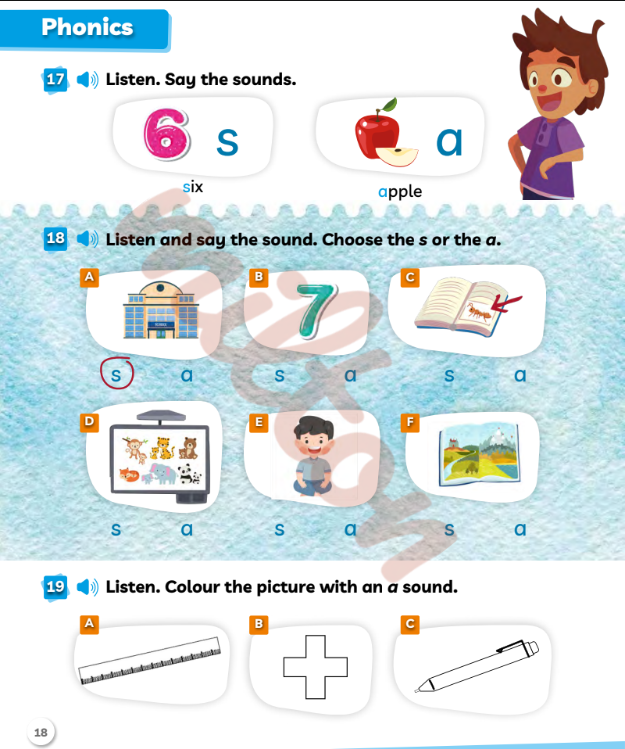
Once students develop a good phonological awareness, it’s time to introduce phonics, that is, the relationship between the letters and sounds of English. But teaching phonics isn’t about memorizing words one after another. It’s about helping students discover that, even in a language as irregular as English, there are recurring patterns.
During the webinar, Maria emphasized the importance of explicitly teaching these patterns so that students can recognize them when they encounter new words. Some examples are common combinations like th or ow, or rules like the well-known Magic e.
When a student understands that the final ‘e’ can transform a short vowel into a long vowel (can → cane), they stop relying solely on memory and begin to use strategies to decipher unfamiliar words. This change has a tremendous impact. Reading ceases to be an exercise in guesswork and becomes a process that the student can understand and control.
This approach is also present in Time Travellers, where the teaching of phonological patterns follows a structured progression adapted to the development of the students, favoring a gradual acquisition of decoding skills.
8. Not all resources designed for native speakers work in an ESL classroom
One of the most repeated messages during the session was the need to critically analyze the materials we use. Many widely known phonics programs, such as Jolly Phonics, were created for children whose native language is English..
That doesn’t mean they can’t be used in an ESL context, but it does raise the question of whether the order in which the sounds are presented really meets the needs of Spanish-speaking students.
Maria raised a very interesting point. If our students already know sounds like /s/, /t/ or /n/ because they also exist in Spanish, does it make sense to dedicate the same amount of time to teaching them as to teaching them phonemes that are completely new to them?
The answer will depend on the context of each center, but the main idea is clear:
We should not copy methodologies designed for native speakers without first adapting them to our students.
9. Planning is as important as the activities

Effective reading instruction depends not only on having good resources, but also on coherent planning. During the webinar, Maria presented the concept of Scope and Sequence, a document that organizes which skills, sounds, and patterns will be taught in each course and in what order.
Far from being a closed document, it should be reviewed periodically and adapted to the students’ actual needs. Having a common sequence helps all teachers follow the same approach and avoids gaps or unnecessary repetition. This idea can also be applied to daily classroom work.
On several occasions, the importance of organizing activities in small groups or learning stations to cater to students with varying levels of reading proficiency was highlighted. When a student needs more support to recognize specific patterns, having more individualized instruction time can make a significant difference in their progress.
In this respect, tools like Read & Play facilitate differentiation, as they allow teachers to assign readings tailored to each student’s level. Thanks to a library organized into 26 levels (from Pre-A1 to B2) and the management options of the Teacher Panel, teachers can monitor each student’s reading progress in a much more personalized way.
10. The goal is not for them to read earlier, but for them to become competent readers.
Perhaps the most important idea of the entire webinar was also the simplest. The goal of teaching reading in English is not for students to memorize a large number of words or to read as quickly as possible. The true goal is to develop competent readers, capable of approaching new texts with strategies that allow them to understand what they read.
To achieve this, we need explicit, structured, and evidence-based instruction. We need to understand how English works as a written system, know the differences with Spanish, and provide our students with tools that allow them to recognize patterns, automate processes, and gain confidence. Because when a student understands how written code works, they stop thinking “I can’t read this” and start thinking “I know where to begin.” And that shift in mindset can completely transform their experience as a reader.
How can we bring these ideas into the classroom?
The good news is that many of these strategies can be incorporated gradually, without needing to completely change the course curriculum. Small actions such as dedicating a few minutes each day to phonological awareness, explicitly teaching patterns, planning a common sequence of phonics exercises, or adapting readings to each student’s actual level can have a very significant impact on the development of reading comprehension.
At Milton Education, we have been integrating these principles into our materials and digital resources for years. In Time Travellers, the progression of content follows a systematic approach to teaching reading and writing, while Read & Play allows each student to access readings adapted to their level, fostering individualized progress without neglecting the shared work of the classroom.
Our goal is the same as that of the webinar: to offer teachers practical and evidence-based tools to help each student become a competent and confident reader.
Webinar: How to Teach Reading in English
: How to Teach Reading in English: Practical Strategies for Pre-Primary & Primary Teachers
In the session you will find more detailed explanations, practical classroom examples, answers to questions raised by teachers and resources that you can apply directly with your students.
Complete the form to access the full webinar recording.