
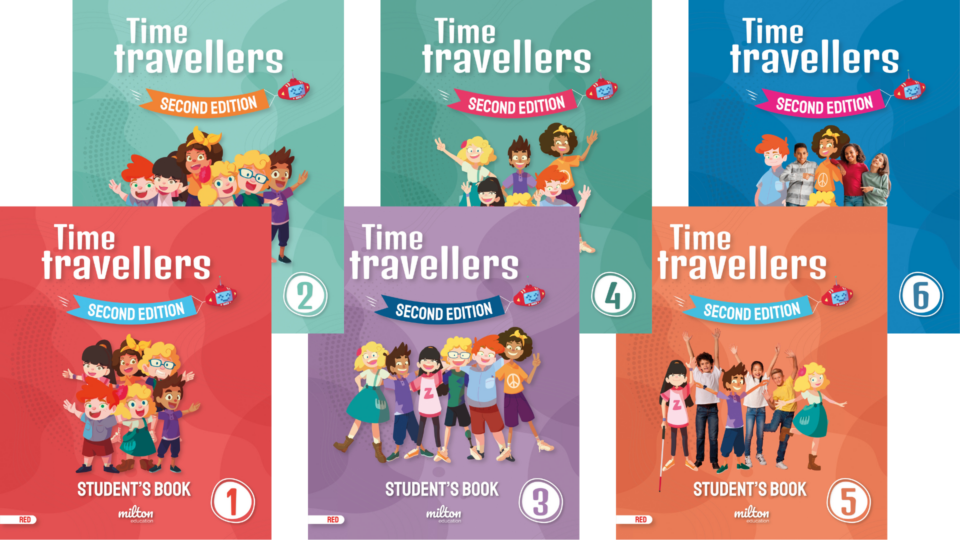
When an educational institution works with Cambridge English learning objectives, a clear question arises when selecting an English teaching method: will it enable us to develop the competencies and achieve the linguistic progression we seek for our students?
Working towards these goals does not necessarily entail using a single type of material. What matters is having an approach that enables the progressive development of various linguistic competencies and provides teachers with the resources needed to reinforce or expand upon specific content whenever necessary.
For this reason, at Milton Education, we have analyzed our Time Travellers Red Second Edition curriculum textbook series (for Primary grades 1 through 6), comparing its progression with Cambridge English learning objectives.
The analysis reveals a high degree of correspondence across the key areas of English learning—Listening, Speaking, Reading, Writing, and Use of English—while simultaneously highlighting a particularly important point: alignment depends not solely on the content of the Student’s Book, but on the full range of resources accompanying the learning process.
What have we analyzed?
To carry out this comparison, we have examined the progression of the Time Travellers curriculum series throughout the entire primary education stage, from Year 1 to Year 6.
The analysis has been organized around five major areas:
- Listening
- Speaking
- Reading
- Writing
- Use of English
For each of them, a review has been conducted of how linguistic objectives are addressed throughout Time Travellers and which resources enable their development or reinforcement.
This is particularly important because a curricular progression does not always entail working on exactly the same content at the same grade level. Some structures may be introduced earlier or later, while others appear implicitly in readings, comprehension activities, or communicative tasks before being addressed explicitly.
The goal is to observe the overall progression and assess the competencies students develop as they advance through primary education.
How does Time Travellers address the key language skills?
Listening: from guided comprehension to increasingly autonomous listening.
Listening comprehension is developed progressively throughout the series. In the early stages, students work with instructions, words, phrases, and short conversations supported by context. As they advance to higher levels, they encounter longer audio recordings and learn to identify both the general idea and increasingly specific information. The goal is not merely to “listen to audio and answer questions,” but to develop strategies for understanding spoken English in various contexts.

Speaking: using English to communicate
One of the main focuses of Time Travellers is the development of communicative competence. From the earliest levels, students find opportunities to ask and answer questions, exchange information, describe, express preferences, and talk about situations relevant to their own lives.
The complexity of these interactions progressively increases, paving the way for increasingly autonomous oral production. Thus, grammar and vocabulary are not treated merely as isolated content; they become tools that students need in order to communicate. This emphasis on listening, speaking, and writing was also a key point highlighted during the curriculum analysis conducted by the team.

Reading: understanding, interpreting, and going beyond the text.
Reading plays a particularly important role in Milton’s educational approach. Throughout primary school, students progressively move from short, visually supported texts to longer, more varied reading materials, working with both fiction and non-fiction.
However, comprehending a text means much more than recognizing its words. The activities enable the development of strategies such as identifying specific information, grasping the overall idea, interpreting information, and—progressively—reflecting on what has been read in order to apply it to one’s own reality.
In addition, the Student’s Book material is extended by Read & Play, which offers an extensive library of graded readers to further develop reading comprehension and tailor the experience to each student’s needs and proficiency level, while incorporating digital tools to foster greater inclusion.

Writing: from the first sentences to different types of texts
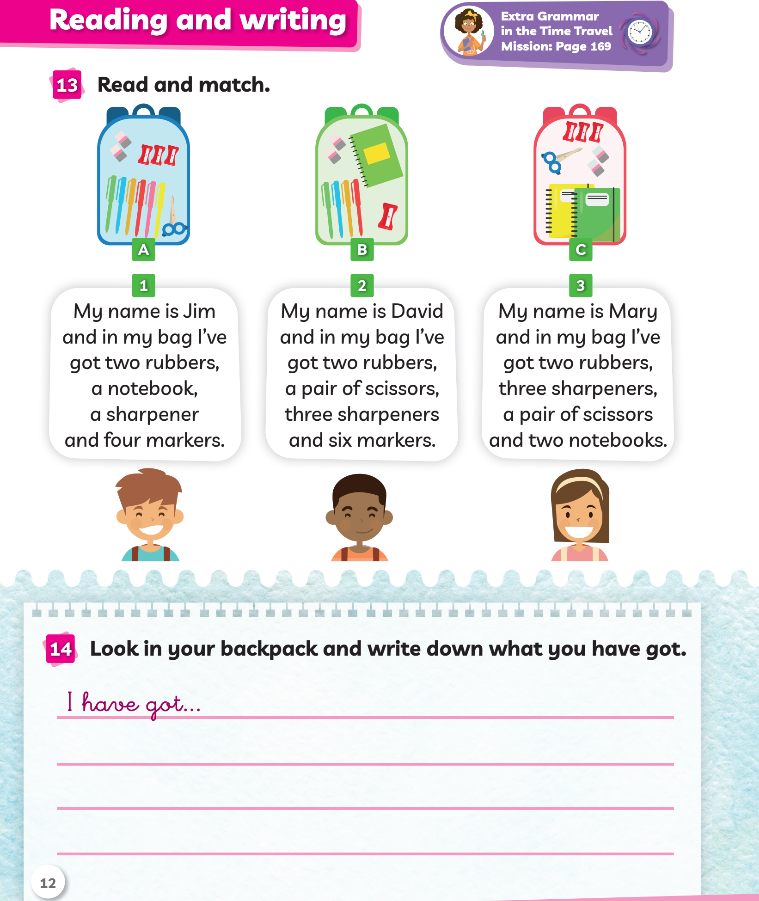
Writing also follows a gradual progression. At the initial levels, students work with words, short phrases, and guided models. Gradually, they begin to organize their ideas and produce texts with a more complex structure.
At higher levels, this progression allows for work with various genres and communicative situations, such as stories, articles, recipes, letters, or biographies. The goal is for students not only to be familiar with vocabulary and grammatical structures but also to learn how to use them to express their own ideas in writing.
Grammar and Use of English: content integrated across different areas
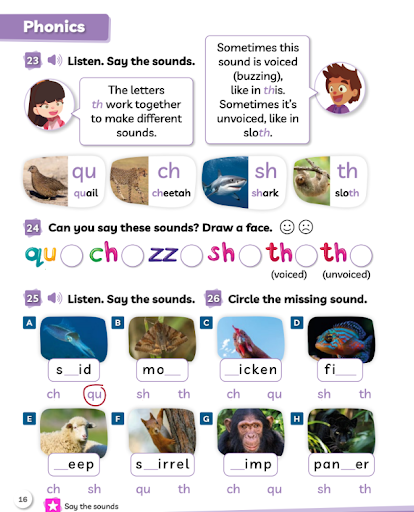
In the Cambridge analysis, “Use of English” encompasses objectives related to grammar, vocabulary, spelling, and the use of linguistic structures. In *Time Travellers*, this content appears both in a dedicated section (Vocabulary, Grammar, Phonics, etc.) and in an integrated manner throughout the Student’s Book, Workbook, and Trainer, as well as in reading materials and speaking and writing activities.


Furthermore, the sequencing does not always align perfectly from one grade to the next. For example, certain structures might be explicitly introduced at a later stage in Time Travellers, even though students have already encountered them in other contexts. What matters is analyzing the full progression from Year 1 to Year 6 of Primary Education, as well as the opportunities students have to understand and use those structures.
The progression at a glance
| Area | How do students progress in Time Travellers? | What do students learn to do? |
|---|---|---|
| Listening | From short, highly contextualized audio clips to more detailed comprehension | Understanding instructions, main ideas, and specific information |
| Speaking | From simple exchanges to more autonomous oral production | Asking and answering questions, describing, expressing opinions, and exchanging information |
| Reading | From short, visually supported texts to longer fiction and non-fiction | Understanding the overall meaning, locating information, and interpreting texts |
| Writing | From guided words and phrases to texts of various genres | Organizing ideas and producing increasingly independent texts |
| Use of English | From basic structures to an increasingly broad linguistic repertoire | Applying grammar and vocabulary in communicative contexts |
Beyond the Student’s Book: a learning ecosystem
One of the most important conclusions of the analysis is that it makes no sense to evaluate the curricular coverage of *Time Travellers* by looking solely at the Student’s Book. The program combines various resources that complement one another.
The Student’s Book sets out the main course path, while the Workbook allows for continued practice and consolidation of the material. These are complemented by Milton’s digital resources, featuring readings and exercises that reinforce various skills and linguistic content. This offers teachers a level of flexibility that is particularly useful when a group’s needs do not align exactly with the planned progression for a specific course.
For example, if a school needs to reinforce a specific objective either before or after it appears in the textbook, it can utilize the platform’s supplementary content. Schools can also request access to other levels when they need to make curricular adaptations for specific students. This gives the teacher various ways to achieve the same learning objective, without relying solely on a specific page in the textbook.

What does all this mean for a center working towards Cambridge English objectives?
For a teaching team, curricular alignment should, above all, provide peace of mind and flexibility. The analysis reveals how the *Time Travellers* series progressively develops key linguistic competencies throughout primary education and how the various components of the Milton ecosystem can complement that progression when needed.
This enables the centers to:
- Plan with greater peace of mind. Teachers can identify how Listening, Speaking, Reading, Writing, and Use of English develop throughout the stage.
- Adapt learning. Supplementary resources make it possible to reinforce specific content and cater to different paces and needs.
- Go beyond linguistic minimums. Phonics, reading, social-emotional learning, projects, and content related to the SDGs expand opportunities to use English in meaningful contexts.
Ultimately, the aim is to build a progression that enables students to develop their communicative competence throughout the entire primary education stage.
Does your center work with Cambridge English objectives?
Each school has a different reality: the number of English hours, starting level, curriculum, language objectives, and the specific needs of the students.
If you are interested in the Time Travellers curriculum series for your school and would like to know more about how its progression aligns with your educational goals, our team can help you analyze your specific needs. Fill in your details below to access the Time Travellers catalog and discover all the new features of the Second Edition.